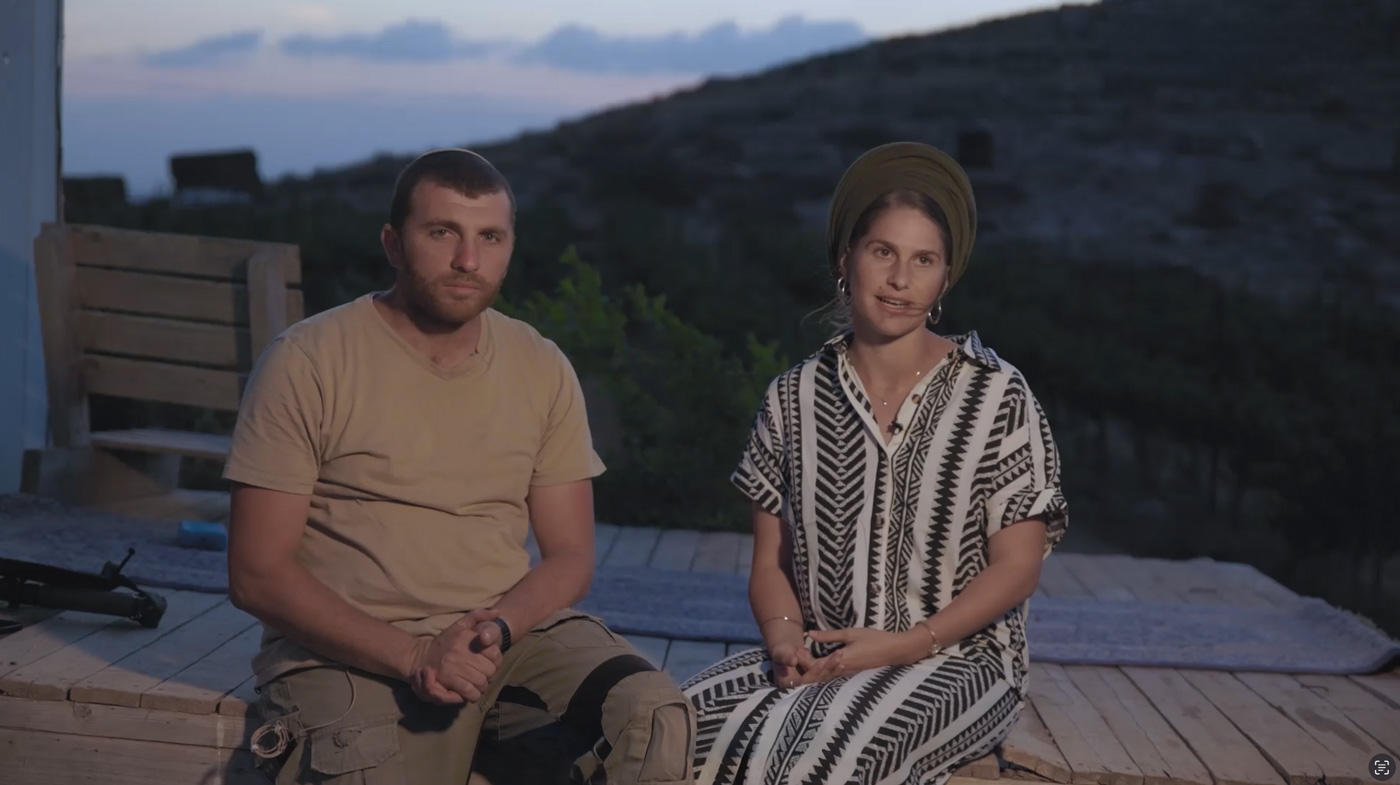
Hagai and Emuna Nissim have been running a family farm deep in the rural frontier for eight years: five children, a herd of 300 sheep, 70 dunams of vineyards, an olive grove, and 8,000 dunams of grazing land. On the surface — agriculture, nature, land. In reality — a daily struggle to maintain a foothold and protect the land.
Before October 7 — Life on a Farm in a Hostile Area
Even before October 7, life there was far from simple.
Nights spent on guard duty, long days of hard labor, and a hostile environment surrounded by villages that did not welcome their presence.
Then, on the morning of Simchat Torah, Hagai was urgently called to his military unit. The realization that he was heading into combat — leaving the farm entirely in Emuna’s hands — made an already complex reality even more difficult.

“It significantly increased my sense of security.”
Emuna
Hagai knew the farm was more than just a livelihood:
“If the herd collapses — everything here collapses. And the area will once again be left exposed.”
Emuna was left to face dozens of daily tasks alone, along with fear and an ever-present sense of insecurity.
“Even with strong faith,” she says, “there is fear in the end — especially when you are alone.”
Simchat Torah: Hagai Goes to Battle — Emuna Holds the Farm
This is where the critical turning point begins — the moment when Moledet changed the equation.
Moledet’s security network entered their lives: field cameras, vigilant observers, and a 24/7 monitoring and control system — all creating a new layer of protection.
Suddenly, the nights felt less lonely, and the area felt less threatening.
Emuna describes the change in simple but powerful words:
“Even if physically we are alone — we don’t feel alone.”
She adds:
“It significantly increased my sense of security.”
When Moledet Enters the Field — Security Grows and Reality Changes
The story of the Nissim family is not just the story of a single farm.
It is a testament to what happens when an entire system stands behind you.
In a reality where every farm is a cornerstone in maintaining territorial presence, an operational–technological network like Moledet’s is not an addition — it is a condition for continued existence.